


Cast under Baracoa's spell in remote Cuba
- Nov 25, 2015
- 7 min read
Her name is Maria. She is as sultry as the thunderstorms that roll in from Atlantic each afternoon. She promises if I buy her a mojito she'll teach me how to salsa. I leave quite an impression. Sadly it's on each of her two high-heeled feet.
I buy Maria another mojito and she asks if I want her to be mine for the night. I politely decline in a smattering of Spanish and after few moments of bashful silence I'm left nursing my half-full drink and Maria's empty glass with its forest of fresh mint leaves.
Spanish guitar and African percussion fill Baracoa's Casa de La Trova with the sounds of changui-son. The casa's host sweeps through the crowd taking more orders for a never-ending stream of mojitos. Maria's feet are soon back gliding across the dance floor. The hand of an elderly Italian tourist rests on the curves of her body. He moves better than I do and he is willing to pay for a girl like Maria.
In the humid cacophony of Cuba's smallest trova house, Maria is not the only beautiful Cuban girl offering salsa lessons for the price of a cocktail or 'amore' for a few extra Cuban pesos. Several girls, in outfits leaving nothing to even the dullest of imaginations, sidle up to foreign men and begin their moonlighting ways. By day these young women, known as jineteras, are teachers, nurses and some even mothers. But one night with a tourist is more than a month's wages and puts extra food on the family table and maybe a few luxuries that are not available with the government issued ration booklet.

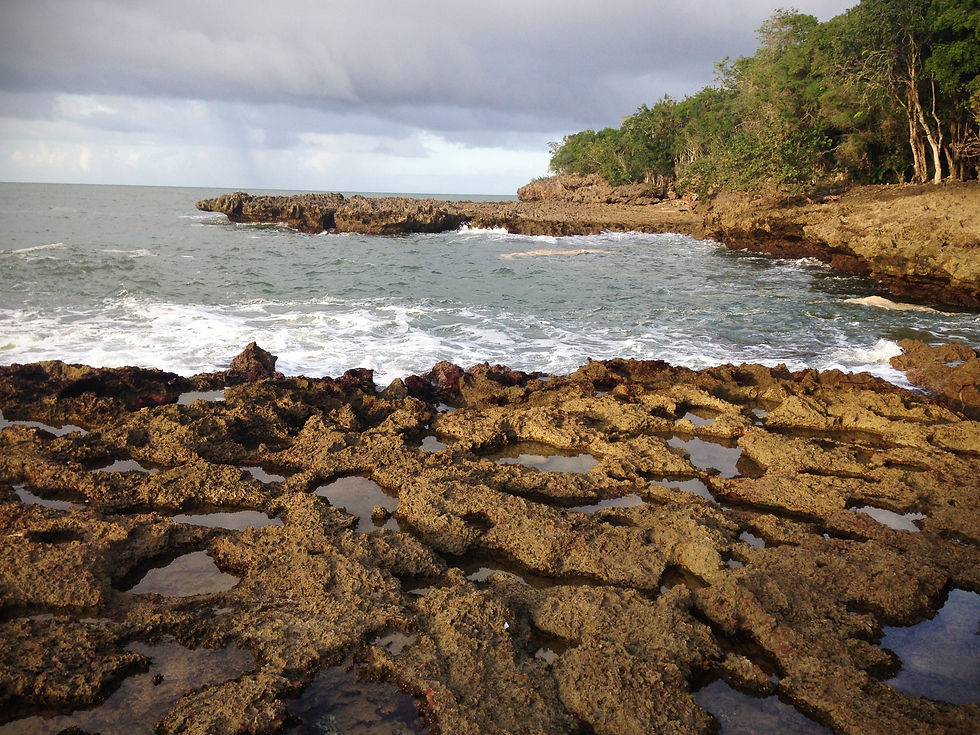
Baracoa is nestled in a small curved bay and it captivated and seduced Christopher Columbus during his first voyage in 1492. He wrote of the area in his logbook ... the most beautiful place in the world ...I heard the birds sing that they will never ever leave this place.... Pine trees cling to the top of steep mountains while royal palms, cocoa plants and coffee bushels swarm the hills surrounding Cuba's most eastern city. Dozens of rivers begin as trickles in the high country before rushing into the turquoise Atlantic sea.
My travel companion and I, while managing to avoid the seduction of exotic Cuban women, have fallen under the spell of Cuba's other charms - rum, cigars, old American cars and music. We've rambled down Havana's famed Malecon and explored the cobbled streets of Trinidad, lingered waiting for a cool breeze in the parks and squares of Santiago de Cuba and basked in the sun on Papa Hemingway's islands in the stream.
Steam is seeping from the wheezing bus. We have lurched, coughing and grinding up La Farola – the lighthouse road – and are perched on the summit of the Sierra del Puril. Below lies Baracoa. A city bounded to the north by the sea and in all other directions by rivers, mountains and forests. These natural barriers kept the region isolated from the rest of Cuba for nearly 450 years. The concrete Lighthouse Road, a gift from Fidel Castro to the faithful revolutionaries of the east, opened in 1964 and paved the way for supplies and tourists to eventually reach the town up over the hills and far far away.

Magic, weird, mysterious and surreal are all used to describe Baracoa, a small city once plundered by Caribbean pirates now filled with wonder, music and temptation. Ancient legends and folklore live side-by-side with a melting pot of characters past and present. Life in Baracoa is out of the pages of a Gabriel García Márquez novel.
Old men and the spirits of Taino Indians gather in the square opposite the cathedral. The men sit and smoke cigars while the rebellious Taino Hatuey, stares defiantly through bronze cast eyes towards the building built by those who burnt him at the stake, for his audacity, more than 500 years ago. A group of smartly uniformed school children splash in coffee-coloured puddles while a crippled woman sells cucurucho, an ambrosia of honey, coconut, nuts and fresh seasonal fruit served in cones of palm bark.
Left to fend for itself shortly after its settlement by the Spanish in 1511, Baracoa became an important centre for Caribbean piracy. In 1652 the port settlement was attacked by pirates and destroyed by fire. Today the city is a jumble of coloured colonial houses with columned facades many crumbling and worn with fatigue or scars from the onslaught of hurricanes. Three fortresses, built to deter bold buccaneers, bound the city and the wall of the Malecon withstands the sea's unrelenting bombardments.
The lush rainforests surrounding Baracoa and threatening to swallow it up like green lava are home to thousands of species of flora and fauna, many of which are rare or endangered. To the northwest is UNESCO World Heritage listed Parque Nacional Alejandro de Humbolt - one of the last and most bio diverse swathes of virgin rainforest left in the Caribbean.
It's a rutted and winding road past the chocolate factory opened by Che Guevara in 1963 that carries us into the park. The thick tangle of forest tumbles down the Saqua-Baracpa mountain range into the sea. The rivers and streams snaking through the park are swollen from the afternoon downpours. It is the tail end of hurricane season.

On our tramp, the wildlife proves elusive. We do catch a glimpse of the beautiful polymita snail, a green Cuban tody flitters briefly on a branch before flying off and the world's smallest frog is almost invisible in the dirt. Karel our guide explains to us the value of the rich and diverse flora to the local people. Food, medicine and poisons are all harvested from Baracoa's fruitful mountain forests. We wash away the warm tropical heat in the cascading roar of a waterfall and return to Baracoa. Lightning rumbles in the distance.
The black sand beach on the southern side of town is swamped with washed up and shattered wood. The sea surges in and touches the shadow cast by Baracoa's wind and rain battered baseball stadium. We sneak in and climb into the empty concrete stand behind home plate. I imagine the crack of a home run and the roar of the crowd before a tap on my shoulder wakes me from my field of dreams moment. A young boy flaps his arms and speaks rapidly to us. I pick up the words "peligroso" and "prohibida".
The stadium has been slammed by one too many hurricanes including devastating Ike in 2008 and the stands are out of bounds because they could collapse at any time. Baracoa baseball fans have to pack in around the grassy outfield to watch their beloved team while only the wind and sea spray fill the stands.
Outside the stadium - and a safe distance from the sagging roof - we meet Raul. He sells beautiful handcrafted wooden toys. The domino set is too good to resist. He also gives us directions to a farm across the Rio Miel where the owner offers private tours of his "finca" under the noses of government officials. They frown upon his commercial enterprise. It is rumoured amidst the coconut groves, chocolate and tobacco plants is a series of caves where the ghosts of Cuba's indigenous people, the Taino, still walk.

"The Taino Indians watched the arrival of Christopher Columbus from this balcony," Inauris Fuentes says as stretches his hand towards the vast expanse of water on the horizon. The view from the rock alcove in the side of the mountain across the verdant green tops of the palms out to the azure blue sea is spectacular. Tragically that same view on a day when Spanish sails appeared in the bay in 1492 proved to be the beginning of the end for the Taino. Within 30 years, it is estimated about 90 per cent of the 100,000 indigenous inhabitants of Cuba had been wiped out.
"Gentle", "sweet", "always laughing" and "without knowledge of evil" were the words used to paint a picture of the Taino by Columbus.
In a hidden corner of the Fuentes' family farm is the Cueva de Aguas, a cave with a sparkling freshwater swimming hole in its pitch-black depths. The cool water tingles on my hot skin and it's a strange sensation as small creatures nibble on my toes in a subterranean world so void of light I'm unable to see my hand in front of my face.
On the hike back to the farmhouse, Inauris points out the patches of cocoa trees and tobacco plants. While the family pockets the small fee they collect for guiding visitors across their land, they can't avoid giving the government its share of the crops – between 80-100 per cent. Asking if we are thirsty, our guide takes our sweaty brows and soaked shirts as a sign we could do with a refreshment break. In moments he is scurrying up a coconut palm and from the dizzying heights hacks a husk from off the top.
The sun is setting as we pay a few pesos to the ferryman to carry us back across the Rio Miel. On the other side kids kick a football around and their shouts and laughter carry above the endless murmur of the sea. On the Malecon a trumpeter competes with the drumming of the waves as they crash into the stone wall. A group of slouching young men offer to sell us a Cohiba cigar – the brand smoked by Fidel Castro and named in honour of the Taino word for tobacco. They ask where we are from and offer to share a sip of their rum.

In the trova house, Maria is not on the dance floor. Maybe she has enough money that she doesn't have to dance with foreigners tonight. The room begins to rock to the voodoo-like rhythms of the changui-son music – born in Baracoa. My mojito glass is almost empty. A beautiful senorita takes a seat next to me and captivates me for a moment with her smile and the cut of her dress. She asks me to dance. "I'm not much of a dancer," I politely explain.
I savour the last sip of my mojito and join the throng of locals outside who can't afford to pay the small entry fee and light up my Cohiba cigar. The smoke dances up into the night sky. It's a gentle breeze that cools sultry, beguiling and mystical Baracoa. The town up over the hills and far far away.






Comments